Early Rome Quiz Show me what you've learned so far about Ancient Rome's beginnings by taking the online quiz here. Star Reading Test Now let's see how much your reading level has improved by taking the Star Reading Test using the link here.
Warm Up Learn about how Ancient Rome was ruled over the years by checking out the link here from BBC Primary History and reading the section "How was Rome ruled?". (Make sure to hover over key terms in yellow to discover their meanings). Then go and participate in a digital conversation about the changing nature of Roman governance at TodaysMeet here. What did you learn about Roman Rule? What surprised you? If you were an ancient Roman, which form of Roman government do you think would have been best? Share and explain your ideas.
EdPuzzle: 'Journals Through History: Ancient Rome' Now head on over to EdPuzzle, login, and locate the video "Journals Through History: Ancient Rome." Use your headphones, watch the video carefully, and answer the questions along the way. If you don't finish in class, the assignment needs to be completed for homework. We will have a quiz on the content tomorrow. Homework (1.)Make at least one appropriate comment at TodaysMeet about Roman rule. (2.)Complete your EdPuzzle. (3.) Study for your quiz. Review and make sure your understand the content from both the BBC Primary History link and the EdPuzzle video.
Warm Up Welcome to Ancient Rome. Romulus and Remus are the legendary twin brothers who according to myth founded the city of Rome. Read about Romulus and Remus here and then take the quiz here. If you have time, watch the Romulus and Remus video below.
Introduction to Ancient Rome: Digital Guided Reading Read along with Mr. Dowling as he introduces you to the new rising power of the ancient world - Rome. After reading, complete the worksheet that accompanies the text that has been placed in each of your Social Studies folders.
The Geography of Ancient Rome: Map Exploration If time permits, check out the site here and using a set of digital maps explore how the geography of Rome changes over time.
Homework Complete the "Ancient Rome: A New Power Rises" assignment.
Warm Up Today we will be learning about one of the most famous and powerful figures in world history: Alexander the Great. Read a short description of Alexander's life and achievements at Ducksters and then share something you learned about the man on your class's Padlet wall. Period 3, your Padlet wall is here. Period 6, you can find your wall here. Alexander the Great Video Hour Let's continue to learn about Alexander the Great through a series of humorous historical videos.The first is from the team at Crash Course; the second is from the creative minds of Horrible Histories. What sort of portrait is being painted of Alexander? Does he come across as 'great' in your mind? If you have any new ideas or things you've learned about Alexander the Great, you may add them to your class's Padlet wall.
Group Discussion: Is Alexander Great or Not So Great? Today you and the members of your team are going to discuss Alexander the Great's achievements and whether they indicate greatness or something else entirely. In your Language Arts folders I have placed guidelines for "Scholarly Discourse." Feel free to use them to help guide your conversation with your classmates. Make a point to express your ideas using academic language, build upon each other's ideas, ask clarifying questions, and even disagree with each other in a scholarly manner.
Athens and Sparta: Writing a Comparison/Contrast Paragraph Today will be your final day to work on writing your comparison/contrast paragraph about Athens and Sparta. Make sure your assignment has a clear topics sentence identifying what is being compared, details illustrating similarities and differences, and signal words to show those similarities and differences. Deadline: Friday, May 16. Ancient Greek God and Goddess Web Exploration Unfortunately, due to time constraints we had very little class time dedicated to learning about Ancient Greek mythology and religion, which many consider to be the most interesting aspects of Ancient Greece. If you finished your comparison/contrast paragraph, you are welcome to use class time today to explore Ancient Greek mythology and religion, especially as it pertains to their gods and goddesses. You may enjoy the websites below.
Athens and Sparta: Writing a Comparison/Contrast Paragraph Today we will take the information we gathered about the differences and similarities between Athens and Sparta and transform them into a well-written comparison/contrast paragraph. Before we do, however, let's take a look at a sample paragraph.
Notice that a good comparison-contrast paragraph includes a clear topic sentence that names two things and identifies whether they are alike, different or both, contains details that illustrate the similarities and/or differences, and uses signal words to emphasize these similarities and differences. You can see the steps to writing a good comparison-contrast paragraph below.
Now it's time for you to write your own your own comparison-contrast paragraph on Athens and Sparta. A copy of the assignment, which includes a list of signal words and an assignment checklist, can be found in your Social Studies folders.
Video Analysis: Sparta and Athens Today we will continue to explore the similarities and differences between Ancient Greece's two most famous city-states, Sparta and Athens. First, we will watch an excerpt from the documentary "Last Stand of the 300," which illustrates the values and harsh lifestyle of the Spartans. Continue to use your Venn Diagram from yesterday to take notes and similarities and differences. You can find the full video below.
Next, we will watch a BrainPop video on life in Athens. I will play the video for you on the Big Screen, but you may also access the video using the BrainPop app in your Google Drive.
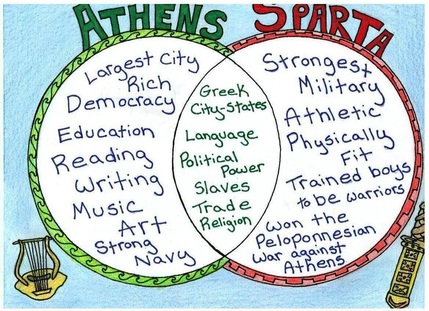
Types of Government: Sparta and AthensNow we will read about the different types of government in Ancient Greece, particularly in Sparta and Athens. A document about Ancient Greek government has been placed in your Social Studies folders. Please open it and let's process it together. Continue to add new details to your Athens/Sparta Venn Diagrams. Tomorrow we will use the similarities and differences about Athens and Sparta that we have gathered to write compare/contrast paragraphs.
Homework Complete your Athens and Sparta Venn Diagram.
Warm Up Based on the research you have done, what do you already know about the city-states of Athens and Sparta? Share your knowledge on your class Padlet wall. 3rd Period, visit your wall here. 6th Period, you can find your wall here. Compare and Contrast: Athens vs. Sparta (Overview) Today we will discuss the similarities and differences between Athens and Sparta. You will find a venn diagram in your Social Studies folders that you will use to compare and contrast these two city-states. Fill out your venn diagram as you watch the video below.
Compare and Contrast: Athens and Sparta (Family and the Role of Women) Continue to compare and contrast Athens and Sparta using your venn diagram while watching this very humorous take on Ancient Greek families and the role of women from Horrible Histories below.
Compare and Contrast: Athens and Sparta (Ancient Greek Rap Battle) Our last compare and contrast video features a rap battle between an Athenian and Spartan. If you learn any new similarities and differences please add them to your venn diagram. WARNING: There are a few offensive lyrics features in the video, which I will do my very best to censor.
Homework (1.) Complete the Athens/Sparta Venn Diagram. (2.) Deadline: The Ancient Greek Writing Assignment is due tomorrow, Tuesday, May 13.
Writing as an Ancient Greek: Let's Write! Today will be you last class period to write your diary/journal entries or letters as an Ancient Greek. I still plan on meeting with each of you during the period to check your progress, answer questions, and offer feedback. If you still need a copy of the guidelines for the assignment, I've placed a copy in each of your new Hapara Social Studies folders. And once again if you haven't already, please move your written assignment into the same new Hapara Social Studies folder. Deadline Reminder: This assignment is due Monday, May 12.
Writing as an Ancient Greek: Let's Write! Today you will have a full uninterrupted class period to write your diary/journal entries or letters as an Ancient Greek. Remember to incorporate historically accurate information, use creative and descriptive details, and capture the voice and personality of your chosen Ancient Greek identity. I plan on meeting with each of you during the period to check your progress, answer questions, and offer feedback. Get inspired and write well! If you need a copy of the guidelines for the assignment, I've place a copy in each of your new Hapara Social Studies folders. And if you haven't already, please move your written assignment into the same new Hapara Social Studies folder. Deadline Reminder: This assignment is due Monday, May 12.
Writing as an Ancient Greek: Assignment Overview Today is the day we begin to actually start writing as Ancient Greeks. But first, let's make sure we are clear about the expectations for the assignment. Let's review the document here and go over assignment guidelines and how it will be graded. When you are ready, you may "create" a document within Google Drive, title it "Writing as an Ancient Greek," and then begin writing! Make sure your assignment is moved to your name folder within your Social Studies folder so I can monitor your progress and so you can receive credit. Deadline: This assignment is due before the start of class on Monday, May 12.
Writing as an Ancient Greek: Fictionalizing History It is almost time to integrate your Ancient Greek research into a series of letters or journal entries written from the perspective of an Ancient Greek. Before you start actually writing, however, I think it would be helpful to look at some examples of historical fiction and fictional diary (journal) entries.
While the entirely fictional "Diary of a Wimpy Kid" is not totally applicable to our historical fiction journal writing activity, there are a few parallels. Author Jeff Kinney is assuming the identity of teenager Greg Heffley, just as you are assuming the identify of an Ancient Greek. Kinney tells his narrative in first-person and uses dates to move the narrative along, as will you.
Looking for actual examples of fictionalized historical diary entries and letters? Look no further. Read and listen to a fictionalized diary entry of a Native American boy living during the 1600's here. Next, read and listen to a fictionalized letter written by a pilgrim girl here. Notice that while the characters are fictional, the historical backdrop of their lives is real, as are the descriptions of their daily lives. The characters also sound like real people that may have actually lived. You are going to want to try to accomplish something similar.
Next, we will review a fictionalized account of an actual historical event known as the "Black Death" written by a modern teenager. Explains the teenage writer: "The Black Death was one of the deadliest plagues in history, and is said to have killed 30-60% of Europe's population in the 14th century. For my history class, we had to write journal entries from the point of view of one who died from this plague, including various, true details from the real event." You can check out her assignment "The Black Death: A Journal of One Who Died" here.
Finally, check out a few actual examples of real-life (not fictionalized) historical diaries and journals online here. Examining how real people from history wrote about their own lives may give you a few ideas about how to write about the life of your fictionalized Ancient Greek self.
Becoming Ancient Greek: Investigative Research Activity Today you will continue to research the details of the lives of the Ancient Greeks in order for you to create a more authentic portrait of a fictional ancient Greek person. Similar to a novelist who researches the topic of their next book before they begin to write, you are researching Ancient Greece so the fictionalized journal entries that you will be writing feel as realistic as possible.
You can still find the document here to record the details of your background. Once again you can and should utilize multiple sources to do your research. Your Social Studies textbooks are a great resource, as is the collection of Ancient Greek books in the front of the classroom. The websites linked below are also a valuable resource for information about Ancient Greece. (I've included a new link by Social Studies teacher Mr. Donn which includes an awesome treasure trove of information.) Tomorrow we will begin writing our journal entries, so try to complete your research today.
Becoming Ancient Greek: Investigative Research Activity Do you ever wish life was like a Magic Tree House book, where you could be magically transported to another time and place? Do you ever wonder what it would have been like to have actually lived during the time of the ancient civilizations we've studied this year? Well, today is your chance. Today you will enter a virtual time machine and assume the identity of an Ancient Greek. You will investigate the details of your daily life, from the clothes you wear to the food you eat, to your place in Greek society. Ultimately, you will integrate your gathered research into a first-person narrative account of your life, told through a written series of journal entries.
Today, however, you focus on establishing who you are and uncovering the details of your life. Before you begin, you must make some decisions. Are you male or female? Are you an adult or a child? Do come from Sparta, Athens, or some other Greek polis or colony? Are you a wealthy aristocrat, a small farmer, a merchant, artisan, or possibly a slave? Once you've established the basic details of your identify, you can dig deeper and locate the more specific and applicable information to help you form a more complete picture of who you are.
To help you start thinking about what Greek identify you may want to assume and to understand what life may have been like for the Ancient Greeks in general, watch the video below.
You will use the document here to record the details of your background you discover during your research today. It also includes some guiding questions that you may want to consider during your investigation. The websites linked below include great information about what life was like for the Ancient Greeks. I also have a large collection of actual books (with pages) in the front of the classroom that you are welcome to peruse. As you explore your various sources, look for authentic details that you think would help create a more complete portrait of your Ancient Greek identify, and record those details on your document. You will use the details next week when you begin writing your series of journal entries written from the perspective of an Ancient Greek.
Life in Ancient Greece: Web Exploration What was it like living in Ancient Greece? Was life different for the wealthy compared to to the poor? What rights and responsibilities did women have? What was life like for boys and girls? What did different people do for work?What food did people typically eat and drink? How did they dress? What was housing like? You will discover the answers to these questions and many more during today's web exploration activity. Today you will be exploring BBC's Primary History Ancient Greeks website. You will focus on three areas: The Greek World, Home Life, and Growing Up in Greece. Explore each of these sections and use the assignment here to record what you learn. If you complete the assignment early and well, you may play the game Greek Hero available on the site's homepage. Homework (1.) Complete your 'Life in Ancient Greece' Website Exploration. This will due next week. (2.) Complete and turn in (to your name folder within your Social Studies folder) all other Social Studies assignments from the week. These include: your Ancient Greece Map Project and the Greek City-State/Polis Activity. Deadline: before the start of class, Tomorrow, May 2.