Thursday, March 30, 2017

The Life of Buddha Comic Strip Project

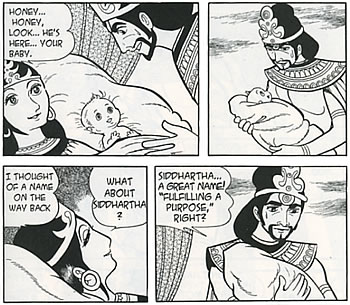
Can you demonstrate what you have learned about the story of Siddhartha Gautama (The Buddha) 
by encapsulating his life in a comic strip, like famed cartoonist and animator Osamu Tezuka did above?

Today's Learning Objective  Know the life and moral teachings of the Buddha. 

Introducing the Comic Strip  Many of you are familiar with comics and comic books, which generally feature a story told a series of panels which include illustrations and dialogue. See an example of the classic "Garfield" comic strip below.


The Life Buddha Comic Strip Project  Today you will begin working on creating a comic strip of focused on the Buddha, as a way of demonstrating what you have learned so far about his life and teachings. Before you can begin working on your comic strip, however, you must complete your Buddha Comic Strip Story Board, which is located in your Social Studies Google Classroom. Once you have your comic planned out, you can begin drawing and designing one in the classic style using paper and colored pencils and markers.

The Life of Buddha Comic Strip Rubric (which can also be found in your Social Studies Google Classroom) explains the various criteria you must meet in order for your comic to be considered 'Proficient' work. 


Below you can find an example panel of a student who chose to make his comic by hand.


An example of a hand-drawn comic strip panel.

Whether you are doing your comic by hand or digitally, please let me know how I can support you. A completed 'Life of Buddha Comic Strip' will be due on WednesdayApril 12.

Friday, March 24, 2017

The Origins of Buddhism: The Life of Buddha


 Today's Learning Objective  Know the life and moral teachings of the Buddha. 

The Life of Buddha: Examining Multiple Sources  Today we will read about the life of Siddhartha Gautama (The Buddha) and how Buddhism came to be. We will read excerpts about the life of the Buddha included in the Interactive Reading Guide of our Ancient Civilizations textbook below. We will also be watching recreations of parts of Buddha's life story featured in the the movies The Buddha and Little Buddha. Ultimately, our goal is to synthesize these three tellings of Buddha's life using the document Important Events in the Life of Siddhartha Gautama (The Buddha)


Thursday, March 23, 2017

Assessing Hinduism


 Today's Learning Objectives  * Explain the major beliefs and practice of the religion of Hinduism. * Determine a central idea of a text and how it is conveyed through particular details.


Assessment: Hinduism Quiz  Today you will be taking a short quiz to demonstrate some of what you have learned so far about the religion of Hinduism. The quiz consists of five multiple choice questions and one short answer paragraph. You can find it here. You are allowed to utilize your Hinduism Study Guide (A Central Idea and Its Parts) notes during the quiz.

Determining the Central Idea of the Hinduism Unit  Over the course of the last several weeks as we have studied Hinduism, you have utilized the document Hinduism Study Guide (A Central Idea and Its Parts). You have taken notes on the parts, the details, and the various elements of Hinduism, while the leaving the 'Central Idea' section blank. What I want you to do today is to review your notes about the various elements of Hinduism in order to determine what is the larger, more central idea about Hinduism they work together to convey. Write a central idea statement about the religion of Hinduism based on the notes you have taken. 

Wednesday, March 22, 2017

The Beliefs of Hinduism: The Three Paths to God

A Hindu pilgrim offers prayers after taking a dip in the Ganges River. 


 Today's Learning Objective  Explain the major beliefs and practice of the religion of Hinduism. 


Guided Reading: 'The Three Paths to God'  Today we are going to learn about the various ways that Hindus practice their religion. As we read excerpts of our Social Studies textbook, Ancient Civilizations, together, continue to take notes using the document Hinduism Study Guide (A Central Idea and Its Parts).


Video: 'The History of Hindu India'  As we near the end of our unit on Hinduism, let's watch the short video "The History of Hindu India," which ties together some of the big ideas we have been learning about. Continue to take notes using your Hinduism Study Guide (A Central Idea and Its Parts) 


Homework  Hinduism Quiz tomorrow! Please study and make sure you understand the basic beliefs of the religion.

Tuesday, March 21, 2017

The Beliefs of Hinduism: Reincarnation and Karma


 Today's Learning Objective  Explain the major beliefs and practice of the religion of Hinduism.  


The Beliefs of Hinduism: Reincarnation and Karma  Today we continue learning about some of the core beliefs Hinduism, while using our Hinduism Study Guide (A Central Idea and Its Parts) document to take notes. Our focus today is on the beliefs of reincarnation and karma. First, we will read excerpts from our Social Studies textbook Ancient Civilizations below. Then we will watch two different videos about Hindu religious beliefs. Remember to keep track of your various sources on your study guide.  


Now we will watch the video "Reincarnation in Hinduism" below. 


Finally, we will end today's lesson by watching Crash Course's take on some of the core beliefs of Hinduism. 


Monday, March 20, 2017

The Basic Beliefs of Hinduism: The Four Goals of Life

Living a moral life, known as dharma, is one of the goals of life for Hindus.


 Today's Learning Objective  Explain the major beliefs and practice of the religion of Hinduism. 


The Basic Beliefs of Hinduism: The Four Goals of Life  Today we will continue our study of the religion of Hinduism, while using our Hinduism Study Guide (A Central Idea and Its Parts) document to take notes. Our focus today is on learning about the "Four Goals of Life" for Hindus. We will read excerpts from our Social Studies textbook Ancient Civilizations below. 


Homework  Continue working on your Hinduism Study Guide (A Central Idea and Its Parts) document. 

Thursday, March 16, 2017

Introduction to Hinduism

Hindu goddesses Saraswati (left) and Lakshmi (center), and the elephant-headed god Ganesh


 Today's Learning Objective  Explain the major beliefs and practice of the religion of Hinduism. 


An Introduction to Hinduism  Today we begin to learn about Hinduism, one of the oldest religions in the world. For more than 2,500 years, Hinduism has been the major religion of India. Over the course of the next couple of weeks, we will learn about and examine Hinduism from multiple sources and perspectives. As you learn about this fascinating and complex religion, I am going to ask you keep track of relevant facts and information you discover using the document Hinduism Study Guide (A Central Idea and Its Parts) (which can be found in your Social Studies Google Classroom). Please use the Study Guide to also make note of your sources of information.

Our first source will be the video "Introduction to Hinduism" featured below. As you watch, make note of the information you learn that you believe is most essential to understanding the religion. 


Hinduism: Sacred Texts and Belief in God(s)  We will now read an excerpt (below) from your Social Studies textbook Ancient Civilizations focused on some of the sacred texts of Hinduism and two of its core beliefs. Continue to make note of what you learn using your Hinduism Study Guide. 


Monday, March 13, 2017

Creating a Caste System Infographic


What Is an Infographic?  In traditional research reports, students gather information, analyze and organize, and then present their findings in essay style. They could  demonstrate all of those findings in another way — with an informational graphic! Informational graphics, also known as infographics, are a way of presenting information, data, or knowledge with the use of visual tools. They are quite ancient; early humans, for example, made maps and other visual representations of their lives which can be seen today. There are a wide range of modern uses for these graphics. Visual presentation of information is a powerful tool. Sometimes a complex concept can be more quickly understood with the use of infographics than through words.

Some examples of infographics can be found below.  Take a moment to look them over. What elements do they all have in common? How is information being presented? What might an infographic about the caste system look like? 


Creating a Caste System Infographic  Now that you know what an infographic is, it's your turn to make your own as a way of demonstrating what you have learned about the caste system. What information about the caste system might you include as part of your infographic? Your infographic may include information about how the caste system began, how it's both similar and different from other social class structures that you've learned about, the different levels (or castes) that make up the system, and its costs and benefits. You may also choose to use have your infographic shine light on the plight of the untouchables by including facts and statistics about their treatment, as well as the existence of caste system discrimination. You may rely on your notes from your Caste System - Study Guide, this Blog, your Social Studies text, and trusted online sources to assist you in gathering the necessary facts and information for this project.

Next, you will have to decide what application you want to use to design your inforgraphic. You may choose to use either Google Drawings or a website that specializes in the design of infographics called easel.ly. If you do choose easel.ly, click the link, login with your Google account, and get started. You may choose to a blank canvas or choose a pre-designed theme. 

Using easel.ly I started work on the infographic in progress featured below. Notice the use of a title, shapes, lines, graphics, images, color, and text. There is a learning curve if you choose to use easel.ly, but I'm willing to show you a few things I've learned so far. If you'd rather stick to what you know, then don't hesitate to use Google Drawing for this project. 

As for grading, this project will count towards your assessment grade. I haven't finalized a rubric but I found the one below online, and I plan on borrowing key elements from it in order to assess your work. Take a look. 

Homework  Continue working on your Caste System infographic, which will be due Friday, Mach 17

Thursday, March 9, 2017

Examining the Caste System and Caste System Discrimination


Examining the Caste System  Today we will continue to examine the caste system by reading an excerpt from our Social Studies text and viewing videos from several different sources. Continue to take notes using the Caste System - Study Guide from yesterday. 

Begin by reading an excerpt from our Social Studies textbook below with the members of your team. According to this source, what are some costs and benefits of the caste system?

Now you will a few videos related to India's caste system. What do these videos add to your understanding of the caste system? Do you find the system unfair? Why or why not? Add your thoughts to the Caste System - Study Guide


Examining Caste System Discrimination  We will now continue to examine the caste system from multiple perspectives, as we take a more critical look at this institution and explorwhat is known as caste system discrimination. You will continue to take notes about what you learn and think using the Caste System - Study Guide

Watch the videos below, which shines light at the plight of the untouchables and the existence of caste system discrimination.


More information about caste discrimination from the International Dalit Solidarity Network can be found below.


Tuesday, March 7, 2017

India's Vedic Age and the Caste System


Today's Focus Question  What impact did the Aryans have on ancient and modern India?


India's Vedic Age: Guided Reading  Today we are going to continue to learn about the impact the Aryans had on ancient and modern India. We will read about what their lives were like and some of their early religious beliefs (which would later become part of the foundation of the religion of Hinduism). Specifically, we will try to understand the Varna system (which the caste system evolved from). As you read and learn about the caste system from multiple sources, you will take notes using the Caste System - Study Guide (which can be found in your Social Studies Google Classroom).  


Videos: The Caste System and the Untouchables  While the caste system has changed and evolved since the days of the Indo-Aryans, it is still an established part of Indian society today. In the videos below, pay special attention to the role and treatment of Dalits (the modern name for untouchables). Continue to use your Caste System - Study Guide to take notes.