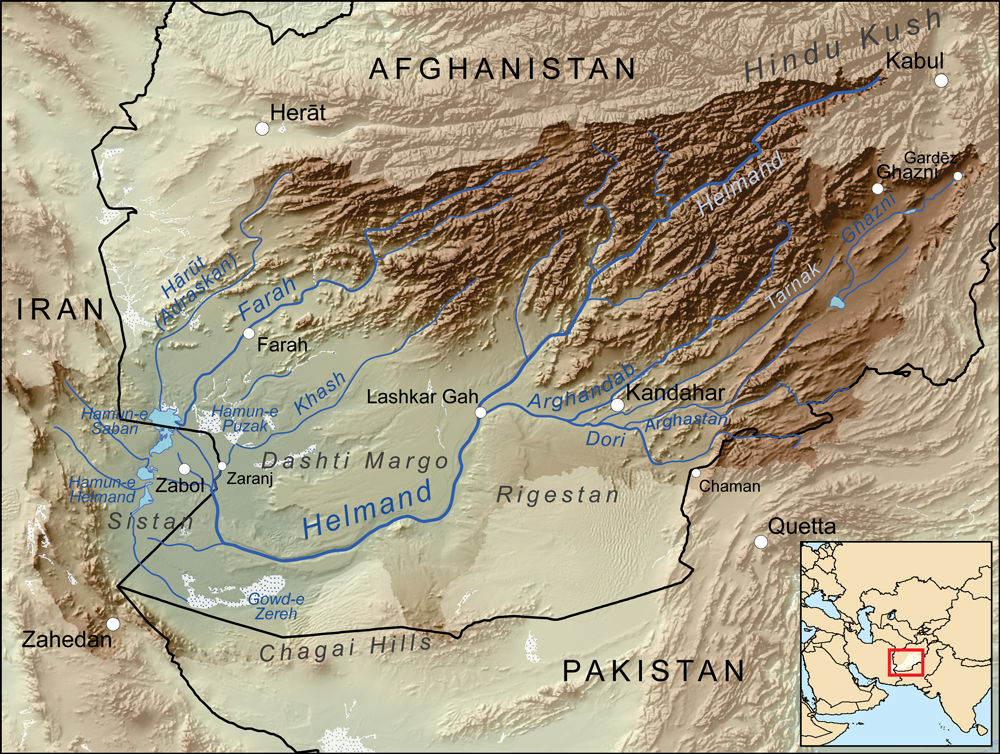
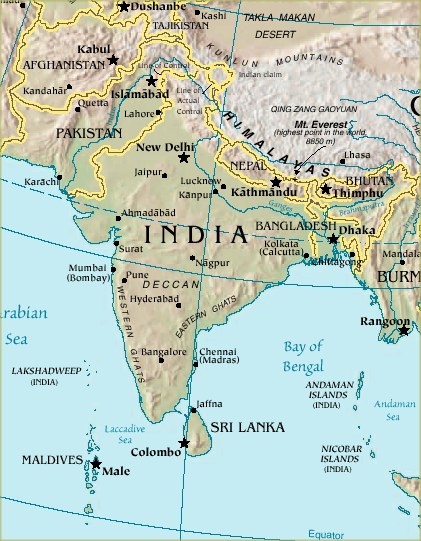
Mapping Activity: The Geography of South AsiaToday you will demonstrate what you have learned about the land, important places, and geographic features in and around the Indian subcontinent, by labeling a blank image of the region (similar to the one featured above). In your Social Studies Google Classroom you can find the assignment Map of South Asia. Directions for how to complete the activity are included with the assignment.
You may utilize various resources to help you complete the activity. The maps below, featured in our Social Studies textbooks and found online, I find particularly helpful.
This mapping activity builds upon content that we have studied in class and serves as one way to demonstrate what you have learned about the geography of ancient India and South Asia. Therefore, it will count towards your Social Studies assessment grade. This assignment will be dueonFriday, February 26.
Today's Focus QuestionHow did geography affect life in India?
Video: Geography and Climate of IndiaWatch the short video below about the geography and climate of India below and then be prepared to share something you learned today.
The Geography of South Asia: Guided Reading and NotetakingToday we will continue to learn about the geography and climate of South Asia. You will be taking notes on these important ideas using the The Geography of South Asia - Notetaking Study Guide. You have two different sources available to locate pertinent information. You may utilize the relevant section of your Social Studies textbook here, and/or you may reference the excerpt from your Social Studies workbook below.
The Indian subcontinent and surroundings.
The Hindu Kush mountains blocked South Asia from the north.
The Himalaya mountain range is a natural barrier that cut off South Asia from China.
The first Indian civilizations began in the Indus River valley.
The Ganges River is another important river in India.
The rains brought by the summer monsoons bring relief from the baking heat.
Farming in Asia depended on the monsoon rains.
In the winter, dry winds blow from the land to the sea. In the summer, wet winds blow from the oceans onto the land.
After watching the "Week in Rap" today be prepared to engage in academic conversations with your teammates.
Academic Conversation # 1: How do you think the Winter Olympics could change in the planet continues to heat up?
Academic Conversation #2: Do you think Facebook's new change to its news feed will encourage more meaningful interactions? Why or why not?
Academic Conversation #3: How do you think this technology could change the way we use our phones to interact with the world? Is this for the better? Why or why not?
To help you dig deeper in your academic conversation refer to the poster below:
Today's Focus QuestionHow did the geography affect life in India?
Introduction to the Geography of South Asia: Writing Warm-Up Study the image above. What do you see? What do you notice about the geography of this part of the world? What geologic features are apparent? What do imagine the climate to be like there? Share your observations on the Google Form here. The Geography of South Asia: Vocabulary StudyToday we start a new unit on the early civilizations of India. We will begin by learning about the geography of this part of the world, and today we will specifically study some of the key vocabulary related is geography, using the document The Geography of South Asia - Cognitive Content Dictionary, which can be found in your Social Studies Google Classroom. We will be using an excerpt from our Social Studies textbook, which has been placed in your Social Studies Google Classroom as well (and which you can also find here), to help us understand the lesson's key words and concepts. Some images have also been posted below to help you conceptualize these new terms.
The Indian subcontinent is very large.
The Himalaya mountains are a natural barrier separating India from China.
The blue lines represent the Indus river system.
Watsonville is home to a lot of fertile land.
Monsoons bring wet winds in the summer and dry winds in the winter.
Mahatma Gandhi & Martin Luther King Jr.: An OverviewToday seems like an ideal day to talk about two of the most important advocates for civil rights and nonviolence our world has ever seen: Mahatma Gandhi and Martin Luther King Jr. In light of our upcoming unit on India, Gandhi is a fitting historical figure to discuss. Gandhi led a nonviolent movement to free his people from British oppression. Martin Luther King Jr., whose birthday and national holiday we are celebrating, was profoundly influenced by Gandhi.
Today as we examine the lives of these two remarkable men, make note of the parallels in their lives, actions, and words, as well as some of the differences. Use the Gandhi and King - Venn Diagram, which can be found in your Social Studies Google Classroom, to record important similarities and differences that you discover.
To begin, we will watch a brief presentation of Gandhi's life through the video "The Gandhi Rap" below.
Now let's examine Martin Luther King Jr.'s life though the video reproduction of the book Martin's Big Words. While watching, do you notice any similarities in the lives of Gandhi and Dr. King? Similarities in the struggles they endured? In the messages they promoted?
Looking to learn more about the lives of Mahatma Gandhi and Martin Luther King Jr.? Explore the Gandhi Presentation and the King Presentationfrom the website Gandhi and King, which honors the life and work of both men. A brief summation from the site of their similarities and differences can be found below.
Gandhi and King: Speaking Up for NonviolenceThere are also parallels in the messages of nonviolence that both Mahatma Gandhi and Martin Luther King Jr. advocated. Let's begin by listening to a rerecording of a famous speech given by Gandhi in which he speaks about the need for non-violent protest in order to gain equality.
Watch below as Martin Luther King Jr. makes clear the influence of Gandhi on his own philosophy of nonviolence.
Now let's read an excerpt from Dr. King's famous "Letter from a Birmingham Jail" which he wrote while imprisoned for organizing a protest march. As you read the text, do you notice similarities to Gandhi's message? How is King's belief in "creative tension" somewhat different than Gandhi's tactic of non-cooperation?
Are Gandhi and King's Messages of Nonviolence Still Relevant Today?What can we still learn from Mahatma Gandhi and Martin Luther King Jr.? Are their messages of nonviolence and peaceful protest relevant in our world today? How can we apply their goals of tolerance, love, peace, and equality to the times we live in now? Before you answer these questions, examine the photographs with captions below.
Gandhi's "March to the Sea" in protest against the British tax on salt (1930).
Martin Luther King leading march from Selma, Alabama, to Montgomery, to protest the lack of voting rights for Africa Americans (1965).
A peaceful 'Black Lives Matter' rally in Minneapolis, Minnesota (2015).
The Women's March, 2017.
Now go to your class's Padlet wall (Period 3 and Period 5) and share your ideas about whether Gandhi and King's ideas are relevant today.