Tuesday, December 9, 2014

Surveys and the Indus Valley Civilization

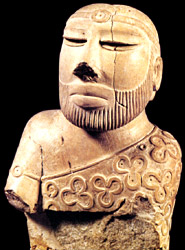
One of the few surviving artifacts depicting what people of the Indus Valley looked like.

7th Grade Social Studies Surveys  Before we begin our lesson on the civilization of the Indus Valley today, we will first participate in a pair of surveys created by students in Ms. Rainey's 7th grade Social Studies class. You can find a link to the student-designed activities on Ms. Rainey's Blog here


 Today's Focus Question  How did people live in the first Indus Valley civilization?


The Indus Valley Civilization: Vocabulary Study  Today we will begin learning about the Indus Valley civilization of ancient India by studying some of the key vocabulary related to this remarkable civilization, using the document The Indus Valley Civilization - Cognitive Content Dictionary, which can be found in your Social Studies folders. We will be using an excerpt from our Social Studies textbook, which has been placed in your Social Studies folders (and which you can also find here), to help us understand the lesson's key words and concepts. Some images have also been posted below to help you conceptualize these new terms.
Young children rely on their parents. 
The organization of Indus Valley cities is clear evidence of central planning.
Food surpluses were stored in the granary
We import a lot of goods from China.
U.S. exports are being shipped to foreign nations. 
Buildings can collapse.
Civilizations can collapse too.

Homework Complete the assignment The Indus Valley Civilization - Cognitive Content Dictionary, which will be due on Friday, December 12  

Monday, December 8, 2014

Computer Science Education Week: Hour of Code


Welcome to Hour of Code  The 'Hour of Code' is a nationwide initiative by Computer Science Education Week to introduce millions of students to one hour of computer science and computer programming. To learn more, watch the videos below. 


 and computer pg.

'Hour of Code' Activity Menu  Each of you will now have an opportunity to choose from a menu of 'Hour of Code' activities designed by the Khan Academy. There will be sound playing, so make sure you have your headphones handy. Review the activities below and select the one that most interests you. Enjoy your hour!


  • Hour of Drawing with CodeThis hour teaches you how to program using JavaScript, one of the world's most popular programming languages. You will use JavaScript to program drawings, finishing with a fun draw-a-wild-animal project. This tutorial requires good typing skills and a keyboard. Recommended ages: 10+. 
  • Hour of WebpagesThis hour teaches you to make your own webpages using the basics of HTML and CSS, finishing with a holiday greeting card. You need good typing skills and a keyboard to program in HTML/CSS. Recommended ages: 10+.
  • Hour of DatabasesThis hour teaches the fundamentals of databases, which are how apps store data about users and content. You will use SQL to create tables, insert data into them, and do basic querying, finishing with a project to create a database for an imaginary store. You need good typing skills and a keyboard to program in SQL. Recommended ages: 12+.
  • Friday, December 5, 2014

    Ancient India: Mapping the Geography of South Asia (Day 2)


    Mapping Activity: The Geography of South Asia Today you will continue to demonstrate what you have learned about the land, important places, and geographic features in and around the Indian subcontinent, by labeling a blank image of the region using the assignment Map of South Asia (which can still be found in your Social Studies folders). Remember the directions for how to complete the activity are included with the assignment. Maps and geography resources of the region can be accessed in yesterday's Social Studies blog entry. 

    Online Game: The Indus Trader  Did you know the very first civilization in India began in place known as the Indus Valley? If you finish your Map of South Asia early today, I would like to invite you to learn about the people that made up one of India's earliest civilizations. Go to the BBC's Primary History: Indus Valley site here. Feel free to explore the site and feel free to play the game Indus Trader in which you get to explore the ancient cities of India.

    Homework  Complete the Map of South Asia, which is formally due next Friday, December 12

    Thursday, December 4, 2014

    Ancient India: Mapping the Geography of South Asia


    Mapping Activity: The Geography of South Asia Today you will demonstrate what you have learned about the land, important places, and geographic features in and around the Indian subcontinent, by labeling a blank image of the region (similar to the one featured above). In your Social Studies Folder you can find the assignment Map of South Asia. Directions for how to complete the activity are included with the assignment. 

    You may utilize various resources to help you complete the activity. The maps below, featured in our Social Studies textbooks and found online, I find particularly helpful. 


    This mapping activity builds upon content that we have studied in class and serves as one way to demonstrate what you have learned about the geography of ancient India and South Asia. Therefore, it will count towards your Social Studies assessment grade. This assignment will be due on Friday, December 12

    Homework  Complete The Geography of South Asia - Notetaking Study Guide and The Geography of South Asia - Cognitive Content Dictionarywhich are both due tomorrow, Friday, December 5.  

    Wednesday, December 3, 2014

    Ancient India: The Geography of South Asia (Day 2)


     Today's Focus Question  How did geography affect life in India?


    Introductory Video: Geography and Climate of India  Watch the short video below and be prepared to share something you have already learned about the geography and climate of India and the surrounding region.


    The Geography of South Asia: Guided Reading and Notetaking  Today we will continue to learn about the geography and climate of South Asia. You will be taking notes on these important ideas using the The Geography of South Asia - Notetaking Study Guide. You have two different sources available to locate pertinent information. You may utilize the relevant section of your Social Studies textbook here, and/or you may reference the excerpt from your Social Studies workbook below. 

    The Indian subcontinent and surroundings.
    The Hindu Kush mountains blocked South Asia from the north.
    The Himalaya mountain range is a natural barrier that cut off South Asia from China.
    The first Indian civilizations began in the Indus River valley.
    The Ganges River is another important river in India.

    The rains brought by the summer monsoons bring relief from the baking heat. 
    Farming in Asia depended on the monsoon rains.
    In the winter, dry winds blow from the land to the sea. In the summer, wet winds blow from the oceans onto the land.

    Homework  Complete The Geography of South Asia - Notetaking Study Guide, which will be due on Friday, December 5.  

    Tuesday, December 2, 2014

    Ancient India: The Geography of South Asia

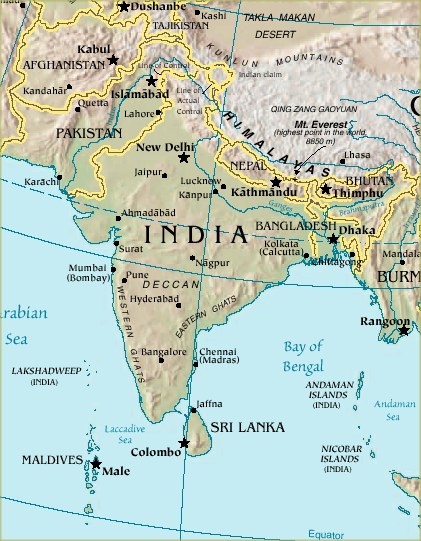
    The Indian Subcontinent 


     Today's Focus Question  How did the geography affect life in India?


    Introduction to the Geography of South Asia: Writing Warm-Up  Study the image above. What do you see? What do you notice about the geography of this part of the world? What geologic features are apparent? What do imagine the climate  to be like there? Share your observations on the Google Form here

    The Geography of South Asia: Vocabulary Study  Today we start a new unit on the early civilizations of India. We will begin by learning about the geography of this part of the world, and today we will specifically study some of the key vocabulary related is geography, using the document The Geography of South Asia - Cognitive Content Dictionary, which can be found in your Social Studies folders. We will be using an excerpt from our Social Studies textbook, which has been placed in your Social Studies folders (and which you can also find here), to help us understand the lesson's key words and concepts. Some images have also been posted below to help you conceptualize these new terms.
      
    The Indian subcontinent is very large.
    The Himalaya mountains are a natural barrier separating India from China.
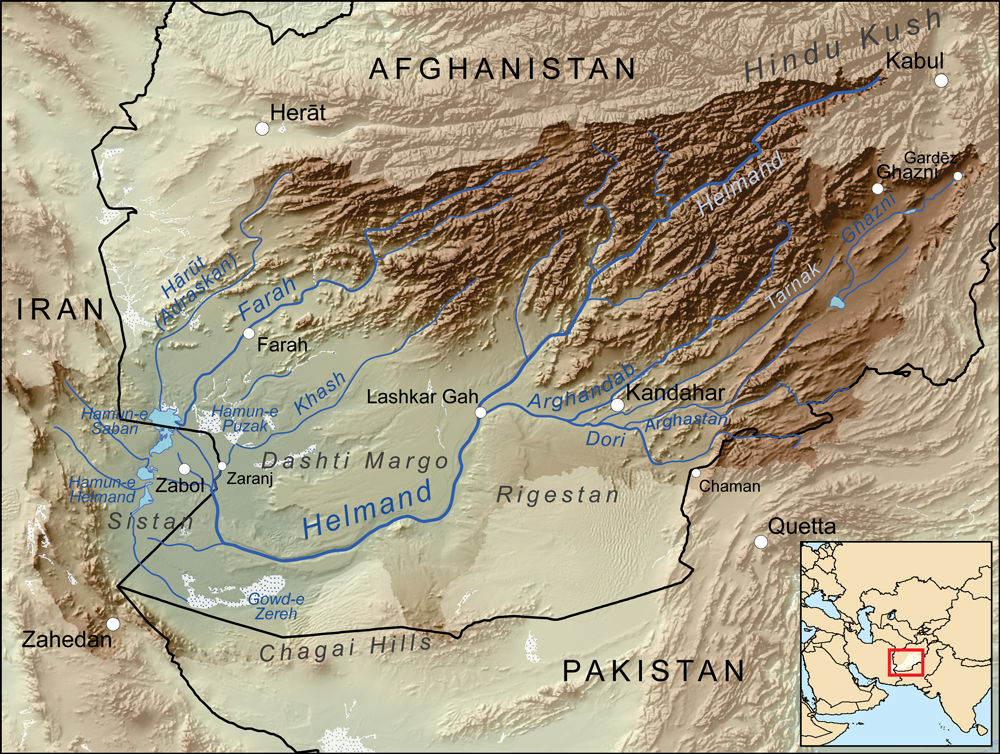
    The blue lines represent the Indus river system.
    Watsonville is home to a lot of fertile farm land. 
    Monsoons bring wet winds in the summer and dry winds in the winter. 

    Video: Geography and Climate of India  Watch the short video below about the geography and climate of India below and then be prepared to share something you learned today. 


    Homework  Complete The Geography of South Asia - Cognitive Content Dictionary, which will be due on Friday, December 5.  

    Monday, December 1, 2014

    Understanding the Ferguson Protests

    Portland Police Sgt. Bret Barnum hugs 12-year-old Devonte Hart during a Ferguson demonstration in the city of Portland earlier this week. Devonte had been standing before a group of police officers, with tears streaming from his eyes, holding a sign that read "Free Hugs." Sgt. Barnum approached and asked Devote why he was crying. Devonte shared his concerns about the level of police brutality directed towards young black kids. Sgt. Barnum responded, "Yes, I know. I'm sorry. I'm sorry." He then asked Devonte if he could have one of his hugs. 

    Building Background: Understanding the Ferguson Protests  Today we are going to take a break from studying and understanding events from ancient history, in order to try to process and understand events that are happening right now in the town of Ferguson, Missouri, and across our nation. Read the Newslea article about recent events here. Next, look at some of the images related to the protests in Ferguson and throughout the country. Finally, watch the news story below. 

    Officer Darren Wilson and 18-year-old Mike Brown
    The vast majority of protestors in Ferguson have been peaceful.
    Mike Brown's mother learns that Officer Wilson will not face criminal charges for her son's killing.
    After the grand jury decision, many protestors' frustration with police and the legal system turns to anger.
    Anger boils over in Ferguson, as some take to the streets, setting fires and looting and destroying property.
    A demonstrator sits in front of street fire during a demonstration following the grand jury decision.
    Protests have been taking place across the nation.
    Protestors gather in Eugene, Oregon, the night after the decision not to indict Officer Wilson.
    Protestors march hand-in-hand in New York City.
    A mother and her children lead a small protest in Minnesota.  

    Padlet Activity: Express Yourself  You have a right to have your voice heard. What do you think about what is happening in Ferguson and across the country? How have you felt watching the news about these events? What are your opinions regarding some of the issues involved? Do you have any questions or concerns? Share your initial thoughts, feelings, questions, and/or concerns on your class's Padlet wall (4th period here and 6th period here). You may choose to leave your comment without a name attached, if it would make you feel more comfortable. Regardless of your viewpoint, however, make sure you maintain a level of respect and civility on this community forum.

    One Man's Perspective: NFL Player Benjamin Watson Speaks Out  Many people have had a lot to say about the events in Ferguson but few have been able to capture the complexity of the issues and feelings involved as well as Benjamin Watson, an NFL football player for the New Orleans Saints. The night of the grand jury decision he penned an emotional response to the news, which he posted on Facebook. Let's spend some time reading and examining his words today. 
    Benjamin Watson's Facebook post has been 'liked' a million times and shared by over 400,000 people.

    Writing Activity: Add Your Voice  How exactly are you feeling about events related to the Ferguson story? Are you feeling angry, scared, confused, sad, sympathetic, hopeless, hopeful, or perhaps something else? Why are you feeling this way? Like Benjamin Watson, try to explore your own feelings and perspectives. In your Social Studies folders, you will find the document How I'm Feeling About Ferguson. After reviewing Benjamin Watson's words again, add your voice. Notice how Benjamin begins each paragraph or stanza with I'M ________, which is followed by an explanation of his feelings. You have been provided a scaffold to do the same. Express one of your feelings and explain why you feel that way. If you are feeling a range of feelings as Benjamin was, don't feel limited to expressing just one. Feel free to explore them all.