Monday, August 22, 2016

Studying the Distant Past


Group Discussion: How do we know what happened in the distant past?  The time before written records is called prehistory. If no one wrote things down long ago, how do we know what happened in the distant past? What sort of things might historians and scientists examine in order to understand what happened in ancient history?  Discuss your ideas with the members of your group and be prepared to share with the class.  

Is there anything that fictional archaeologist Indiana Jones can teach us about how we study and understand the distant past? 


Studying the Distant Past: Vocabulary Study  Today we are going to learn some of the key vocabulary and concepts related to the study of the distant past by using a vocabulary study guide called a Cognitive Content Dictionary (CCD). You can find your Studying the Distant Past - Cognitive Content Dictionary and a reading selection related to our topic of study (which corresponds to pgs. 6 - 11 of your Ancient Civilizations textbook) in your Social Studies Google Classroom. 

Using your CCD you will think about what you already know about the word, include a definition and image, and finally use the word in a sentence.

Homework  Complete and 'turn in' your Studying the Distant Past - Cognitive Content Dictionary by this Friday, August 26 in order to receive full credit. 

Friday, August 19, 2016

The Past, Present, and the Future

"Know your past. It is the foundation for your present, and the path to your future." 
- Pulani Kanahele

Google Mapping Activity  Take a few minutes to put the finishing touches on our collaborative Google Map about the special places we visited during summer vacation. Then be prepared to take share out about your special place, while also learning about the travels of your classmates. 


Why Study History?  In our Social Studies course this year part of our focus will be on studying early human history and ancient civilizations. But why? Why should we care about happened thousands or even millions of years ago? Why does what happened in the past matter to us now? Why do we study history in general and why should we care? Turn to the members of your table group and have a discussion about why you think it is important to study and understand what happened in the distant past. Discuss why learning and appreciating history is worth our time. 

Next, let's watch the perspective of a history teacher in the video below about why he believes knowing history is important. 


Flocabulary: The Week in Rap  Not only is it important to understand the past, but it's also critical to make connections to what is happening right now. Many important news events took place this around the world this week. Let's review some of them with our friends at Flocabulary.

https://www.flocabulary.com/topics/week-in-rap/

Thursday, August 18, 2016

Mapping Our Summer Vacations


Getting Started with Google Maps  Today we will continue to get to know each other, while becoming oriented with our Chomebooks and its various Google applications. In today's lesson you will learn about Google Maps and use a shared digital class map to locate and describe a special place from your summer vacation. Check out the tutorial video below, featuring yours truly, to get started.


Now it's your turn. Please visit your Social Studies Google Classroom and locate the link to your class's Google Map and to find out more about this project. 

Wednesday, August 17, 2016

Community Building


Back-To-School Scavenger Hunt  Let's continue to get to know each other. For each question on the Scavenger Hunt worksheet find someone in class who shares that attribute and have them sign the answer blank for that question, as well as provide additional information. Don't have the same person sign for each question. Avoid talking to people you already know. Be brave and meet new people! We are all in this together!

Thursday, May 19, 2016

Welcome to Ancient Rome


 Today's Learning Objective  * Identify the location and describe the rise of the Roman Republic, including the importance of such mythical and historical figures as Aeneas, Romulus and Remus, Cincinnatus, Julius Caesar, and Cicero. 


Warm-Up  Welcome to Ancient Rome. Romulus and Remus are the legendary twin brothers who according to myth founded the city of Rome. Read about Romulus and Remus here and then take the quiz here. Next, we will watch the Romulus and Remus video below.  


Introduction to Ancient Rome: Digital Guided Reading Read along with Mr. Dowling as he introduces you to the new rising power of the ancient world - Rome. After reading, complete the Ancient Rome: A New Power Rises (Reading and Fill-in-the-Blank) worksheet that accompanies the text, which you can find in your Social Studies Google Classroom. 


The Geography of Ancient Rome: Map Exploration If time permits, check out the site here and using a set of digital maps explore how the geography of Rome changes over time.
  

Homework Complete the Ancient Rome: A New Power Rises (Reading and Fill-in-the-Blank) assignment.  

Friday, May 13, 2016

Greek Gods and Goddesses and Comparison/Contrast Paragraph Writing

How many of the ancient Greek gods and goddesses can you identify?

 Today's Learning Objective  * Compare and contrast life in Athens and Sparta. * Explain the significance of Greek mythology to the everyday life of people in the region. 


Athens and Sparta: Writing a Comparison/Contrast Paragraph Your Athens and Sparta - Comparison/Contrast Paragraph is due today. This class period is your last opportunity to work on in. Please make sure your assessment paragraph has a clear topics sentence identifying what is being compared, details illustrating similarities and differences, and signal words to show those similarities and differences.

Ancient Greek God and Goddess Web Exploration Unfortunately, due to time constraints we had very little class time dedicated to learning about Ancient Greek mythology and religion, which many consider to be the most interesting aspects of Ancient Greece. If you finished your comparison/contrast paragraph, you are welcome to use class time today to explore Ancient Greek mythology and religion, especially as it pertains to their gods and goddesses. You may enjoy the websites and videos below.  

Thursday, May 12, 2016

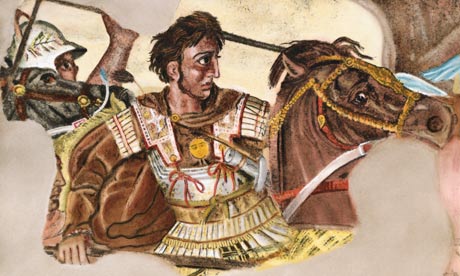
What's So Great About Alexander?


 Today's Learning Objective  * Trace the rise of Alexander the Great and the spread of Greek culture. 


Warm-Up  Today we will be learning about one of the most famous and powerful figures in world history: Alexander the Great. Read a short description of Alexander's life and achievements at Ducksters and then be prepared to share something you learned about with the class.

Alexander the Great Video Hour  Let's continue to learn about Alexander the Great through a series of videos. The first comes from history teacher Mr. Corwin; the second from WatchMojo; and finally the third from the team at Crash Course. What sort of portrait is being painted of Alexander? Does he come across as 'great' in your mind?


Group Discussion: Is Alexander Great or Not So Great? Today you and the members of your team are going to discuss Alexander the Great's achievements and whether they indicate greatness or something else entirely. Check out these guidelines for "Scholarly Discourse." Feel free to use them to help guide your conversation with your classmates. Make a point to express your ideas using academic language, build upon each other's ideas, ask clarifying questions, and even disagree with each other in a scholarly manner.