CNN Student News As we watch CNN Student News today, identify one or two news stories that you can pinpoint geographically and place on the Current Event layer of your Social Studies World Map via Google Maps.
Fiery Cross Reef (600 miles off the coast of China); Hiroshima, Japan;Pyongyang, North Korea;Fort McMurray, Alberta, Canada;and Milton, Massachusettswere all featured in today's segment. After
pinning at least one of these places on your map, consider the most
important question: What happened here? You should include a title for the event, the
date(s) the event took place, a brief summary of what happened, and
include an appropriate photo or video. If you need to refer to a transcript of today's broadcast you can find it here.
Athens and Sparta: Writing a Comparison/Contrast ParagraphToday you will continue working on yourAthens and Sparta - Comparison/Contrast Paragraph, which is duethis Friday, May 13. Take a look at the rubric so you're clear about how you'll be assessed.
Today's Learning Objective * Compare and contrast life in Athens and Sparta.
Warm-Up Flocabulary Video: Compare and Contrast Learn how to compare and contrast from Flocabuary.
Athens and Sparta: Writing a Comparison/Contrast ParagraphToday
we will take the information we gathered about the differences and
similarities between Athens and Sparta and transform them into a
well-written comparison/contrast paragraph. Before we do, however, let's
take a look at a sample paragraph.
Notice
that comparison-contrast paragraph includes a clear topic sentence that
names two things and identifies whether they are alike, different or
both, contains details that illustrate the similarities and/or
differences, and uses signal words to emphasize these similarities and
differences. You can see the steps to writing a good comparison-contrast
paragraph below.
Now it's time for you to write your own your own comparison-contrast paragraph on Athens and Sparta. The assignment Athens and Sparta - Comparison/Contrast Paragraph, which includes a list of signal words and an assignment checklist, can be found in your Social Studies Google Classroom. This assignment will be dueFriday, May 13.
Today's Learning Objective * Compare and contrast life in Athens and Sparta.
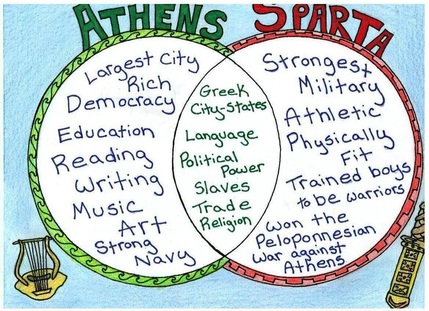
Video Analysis: Sparta and AthensToday we will continue use our Athens and Sparta - Venn diagram to
explore the similarities and differences between Ancient Greece's two
most famous city-states, Sparta and Athens. First, we will watch a
compilation of scenes from the movie 300,
which illustrates the values, emphasis on war, and harsh lifestyle of
the Spartans. Continue to use your Venn Diagram from yesterday to take
notes and similarities and differences.
Next,
we will watch a BrainPop video on life in Athens. I will play the video
for you on the Big Screen, but you may also access the video using the
BrainPop app in your Google Drive.
Types of Government: Sparta and AthensNow we will read about the different types of government in Ancient Greece, particularly in Sparta and Athens. Open the document Government in Ancient Greece (Sparta and Athens)
and
let's process it together. Continue to add new details to your Athens and Sparta - Venn diagram.
Tomorrow we will use the similarities and differences about Athens
and Sparta that we have gathered to write compare/contrast paragraphs.
CNN Student News As we watch CNN Student News today, identify one or two news stories that you can pinpoint geographically and place on the Current Event layer of your Social Studies World Map via Google Maps.
Russia (bordering the Black Sea)and the South ChinaSeawere both featured in today's segment. After
pinning at least one of these places on your map, consider the most
important question: What happened here? You should include a title for the event, the
date(s) the event took place, a brief summary of what happened, and
include an appropriate photo or video. If you need to refer to a transcript of today's broadcast you can find it here.
Flocabulary's 18 Years in RapListen along as our friends at Flocabulary rap about the most important news stories of the last 18 years. Which events are you familiar with? Which events would you like to research and learn more about?
Today's Learning Objective * Compare and contrast life in Athens and Sparta.
Video Warm-UpIn order to continue to familiarize ourselves with the legacy of the ancient Greeks check out this video.
Compare and Contrast: Athens vs. Sparta (Overview)Today we will discuss the similarities and differences between the two most famous groups of ancient Geeks: the Athenians and the Spartans. You will find a Athens and Sparta - Venn diagram
in your Social StudiesGoogle Classroom that you will use to compare and
contrast these two city-states. Learn about what a city-state is, as well as the similarities and differences between Athens and Sparta as you fill out your venn diagram and watch
the videos below.
Compare and Contrast: Athens and Sparta (Family and the Role of Women)Continue
to compare and contrast Athens and Sparta using your venn diagram while
watching this very humorous take on Ancient Greek families and the role
of women from Horrible Histories below.
Video Warm-UpThe Ancient Greeks were known for their revolutionary politics and groundbreaking ways of thinking, and are called the fathers of Western civilization. But how much about them do you actually know? Watch the video below for a brief introduction.
Who Were the Ancient Greeks?: Web ExplorationWhat's the story of early Greek history? How was ancient Greece ruled? What
was it like living in ancient Greece? What did a typical ancient Greek family look like?What were Greek homes like? What
food did people typically eat and drink? How did they dress? How did children play? You will discover the answers to these questions and many
more during today's web exploration activity. Today you will be exploring BBC's Primary History Ancient Greeks website. You will focus on two areas: Who Were the Ancient Greeks? and What was it like to live in an ancient Greek Family?. Explore both sections and use the assignment BBC Primary History: The Ancient Greeks Website Exploration, which can be found in your Social Studies Google Classroom, to record what you learn.
Today's Learning Objective * Discuss the connections between geography and the development of city-states in the region of the Aegean Sea.
CNN Student News As we watch CNN Student News today, identify one or two news stories that you can pinpoint geographically and place on the Current Event layer of your Social Studies World Map via Google Maps.
Kenya; Iraq;Puerto Rico;and Chinawere all featured in today's segment. After
pinning at least one of these places on your map, consider the most
important question: What happened here? You should include a title for the event, the
date(s) the event took place, a brief summary of what happened, and
include an appropriate photo or video. If you need to refer to a transcript of today's broadcast you can find it here.
Ancient Greece Map ProjectGreek
civilization developed on dry, rocky lands surrounded by water. Most of
Greece consists of a large peninsula, however the seas surrounding
Greece also contain hundreds of small islands. Ancient Greece's unique
geography made it a crossroads for travelers and traders who exchanged
goods, ideas, and customs. Today you will have the opportunity to make a
detailed map of Ancient Greece, featuring important regions, cities,
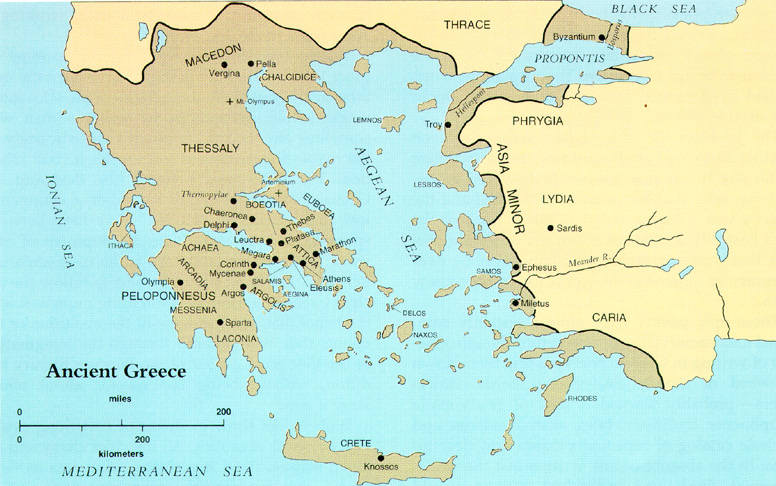
bodies of water, islands, and other land forms. Map Instructions (Greece) have been placed in your Social Studies Google Classroom. The assignment Map of Greece has also been placed in your Social Studies Google Classroom. A sample map is here. Additionally, to help you complete the project, a collection of maps of Ancient Greece from the British Museum can be found here.
A detailed map of Ancient Greece has also been posted above and below.
You are also welcome to conduct your own independent research to help
you complete your map. TheMap of Greece will count as an assessment and be due this Friday, May 6.